Lead Generation: A Complete Guide to Attracting and Converting More Customers
In today’s competitive digital environment, businesses need a reliable way to attract potential customers and turn their interest into sales. This is where lead generation becomes essential.
Whether you operate a small business, an online store, a B2B company, or a professional service business, generating qualified leads can help create a consistent flow of sales opportunities.
But what is lead generation, and how can businesses build an effective strategy?
This guide explores the lead generation process, popular techniques, useful tools, common mistakes, and practical methods to generate high-quality leads for your business.
What Is Lead Generation?
Lead generation is the process of attracting individuals who may be interested in your products or services and encouraging them to share their contact details or take another meaningful action.
A potential customer can become a lead by:
Filling out a contact form
Signing up for a newsletter
Requesting a product demo
Downloading an eBook or guide
Registering for a webinar
Asking for a quotation
Calling your business
Sending an inquiry through social media
The goal is not simply to gather as many contacts as possible. Effective lead generation focuses on attracting relevant and qualified prospects who are more likely to become actual customers.
Why Is Lead Generation Important for Businesses?
A strong lead generation strategy provides businesses with a dependable way to connect with potential customers.
Without a reliable source of prospects, sales teams may depend heavily on referrals, cold calls, or occasional inquiries. A structured approach can help create a continuous stream of new opportunities.
Some of the key benefits include:
1. Builds a Consistent Sales Pipeline
Businesses require a steady flow of potential customers. Lead generation helps sales teams maintain a healthy pipeline instead of relying only on repeat customers or referrals.
2. Increases Brand Awareness
Content marketing, search engine optimization, social media, and advertising can introduce your business to people who have not previously interacted with your brand.
3. Helps Identify Potential Customers
Lead generation activities can gather valuable information about prospects, including their interests, business needs, location, and buying intentions.
4. Supports Business Growth
When more qualified prospects enter the sales funnel, sales teams have more opportunities to build relationships, convert prospects, and generate revenue.
How Does the Lead Generation Process Work?
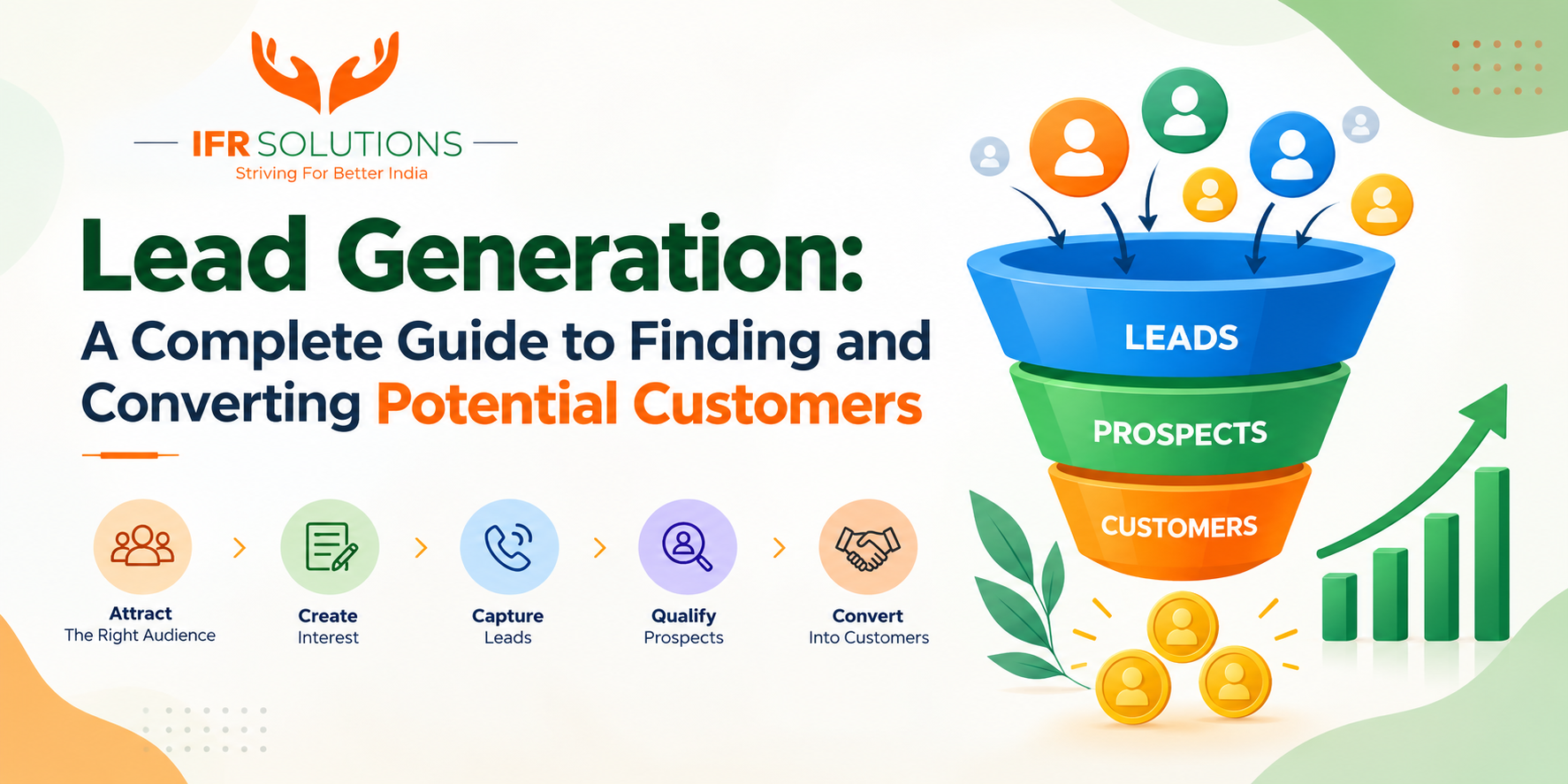
The lead generation process typically starts with attracting the right audience and ends with converting qualified prospects into customers.
A basic process looks like this:
Attract → Engage → Capture → Qualify → Nurture → Convert
Step 1: Attract
First, businesses need to reach people who may have a problem or need that their product or service can solve.
Channels such as search engines, social media, paid advertising, blogs, videos, and referrals can help attract potential customers.
Step 2: Engage
Once people discover your brand, provide valuable information that encourages them to learn more.
Educational articles, case studies, videos, webinars, and product guides can be effective ways to engage potential customers.
Step 3: Capture
The next step is to give visitors an opportunity to become leads.
This might include:
A contact form
Newsletter subscription
Consultation request
Product demo request
Downloadable resource
Free assessment or quote
Step 4: Qualify
Not all leads have the same level of interest or buying potential.
Businesses can assess leads based on factors such as:
Customer needs
Budget
Company size
Level of engagement
Purchasing authority
Buying timeline
This helps sales teams focus their efforts on prospects who are more relevant to the business.
Step 5: Nurture
Some prospects may not be ready to make a purchase immediately.
Email campaigns, useful content, follow-ups, educational resources, and personalized communication can help maintain relationships with these prospects until they are ready to take the next step.
Step 6: Convert
When a prospect is ready to buy, the sales team can move the opportunity toward a purchase.
A smooth transition between marketing and sales can make the overall process more efficient.
Effective Lead Generation Strategies
There are many ways to generate leads. The best approach depends on your target audience, industry, budget, and business model.
Below are some commonly used lead generation strategies.
1. Search Engine Optimization
Search engine optimization, or SEO, can help your website appear when potential customers search for information, products, or services related to your business.
For example, a software company might create content around topics such as:
Business automation
CRM software
Productivity tools
Customer management
Business technology
A successful SEO strategy can attract visitors who are already searching for solutions related to your products or services.
2. Content Marketing
Content marketing is another important part of a lead generation strategy.
Businesses can publish different types of valuable content, including:
Blog posts
Guides
Case studies
Whitepapers
Videos
Infographics
Research reports
Industry insights
Creating useful and informative content can help establish credibility while encouraging website visitors to take the next step.
The content should focus on answering customer questions and solving real problems rather than simply promoting products or services.
3. Social Media Marketing
Social media platforms such as LinkedIn, Facebook, Instagram, and other online networks can help businesses connect with potential customers.
Social media lead generation can involve:
Educational content
Paid advertisements
Direct messages
Webinars
Lead forms
Promotional campaigns
Customer testimonials
However, businesses should focus on platforms where their target audience is most active.
For example, a B2B company may focus more heavily on professional networking platforms, while a consumer-focused brand may find greater engagement on visual or community-driven platforms.
4. Email Marketing
Email remains a valuable tool for nurturing relationships with people who have already shown interest in a business.
A company can use email marketing to share:
Educational content
Product updates
Case studies
Special offers
Industry news
Helpful resources
The objective should be to provide relevant information rather than sending too many promotional messages.
Personalized and useful emails can help businesses remain connected with prospects throughout the buying journey.
5. Paid Advertising
Pay-per-click advertising and social media advertising can help businesses reach specific audiences quickly.
Advertising campaigns can direct users to dedicated landing pages focused on a particular offer or conversion goal.
Businesses should track important metrics such as:
Cost per lead
Conversion rate
Customer acquisition cost
Click-through rate
Return on advertising spend
These metrics can help determine how effectively an advertising campaign is generating business opportunities.
6. Landing Pages
A landing page is designed to encourage visitors to take a specific action.
An effective landing page typically includes:
A clear headline
A strong value proposition
Brief supporting information
A visible call to action
A simple form
Trust signals such as testimonials or case studies
Removing unnecessary distractions can make it easier for visitors to understand the offer and complete the desired action.
For example, if the goal is to generate consultation requests, the page should clearly explain the benefit of the consultation and provide an easy way for visitors to submit their information.
7. Webinars and Online Events
Webinars can attract people who are interested in learning about a specific topic.
For B2B companies, webinars can be particularly useful because they provide an opportunity to:
Showcase industry expertise
Answer customer questions
Explain complex topics
Demonstrate products or services
Build relationships with potential customers
A webinar can also become a source of additional content. Businesses can turn webinar recordings into blog posts, videos, social media content, or downloadable resources.
B2B Lead Generation vs. B2C Lead Generation
Lead generation strategies can vary depending on the nature of the business and the buying process.
B2B Lead Generation
B2B lead generation usually involves longer buying cycles and multiple decision-makers.
Businesses may use:
LinkedIn marketing
Industry reports
Webinars
Email marketing
SEO
Case studies
Product demonstrations
Sales outreach
B2B customers often require more information before making a purchasing decision, so educational content and relationship building can play an important role.
B2C Lead Generation
B2C businesses often deal directly with individual consumers.
Common approaches include:
Social media marketing
Search advertising
Email marketing
Promotional campaigns
Influencer marketing
Content marketing
Product-focused landing pages
The buying journey can vary significantly depending on the product, price, industry, and customer.
For both B2B and B2C businesses, understanding the target audience is essential for creating an effective lead generation strategy.
Key Takeaway
Successful lead generation is not simply about collecting a large number of contact details. It is about attracting the right audience, providing valuable information, building trust, and creating a clear path from initial interest to purchase.
Businesses can combine SEO, content marketing, social media, email marketing, paid advertising, landing pages, and webinars to build a consistent flow of qualified opportunities.
The most effective strategy will depend on your target audience, business goals, industry, and available resources. By continuously measuring performance and improving your approach, you can create a more reliable and sustainable lead generation process.
Related News