How Does Sales Work ? Understanding the Sales Process
When you hear the word sales, what comes to mind?
For many people, it's a salesperson trying to convince
someone to buy something. But that's only one small part of it.
Today, sales is much more about understanding people, their
needs, their problems, and what they are actually looking for. A good
salesperson doesn't simply talk about a product or service. They listen, ask
questions, build trust, and then explain how their solution can genuinely help.
Whether a business sells products, services, software, or
professional solutions, having a clear sales process can make the entire
journey easier—for both the business and the customer.
So, how does sales actually work?
Let's take a look at the process step by step.
What Is Sales?
In simple terms, sales is the process of helping a potential
customer move from having a need or problem to choosing a solution that can
address it.
It usually involves several steps. You need to find
potential customers, start conversations, understand what they need, explain
your solution, answer their questions, handle concerns, and eventually help
them make a decision.
But there's an important point to remember.
Good sales isn't about convincing someone to buy something they don't need.
It's about finding the right customer, understanding their
situation, and showing them how your product or service can provide value.
That's why listening is often more important than talking.
How Does the Sales Process Work?
There isn't one fixed sales process that works for every
business. The approach can change depending on the industry, product, customer,
and type of business.
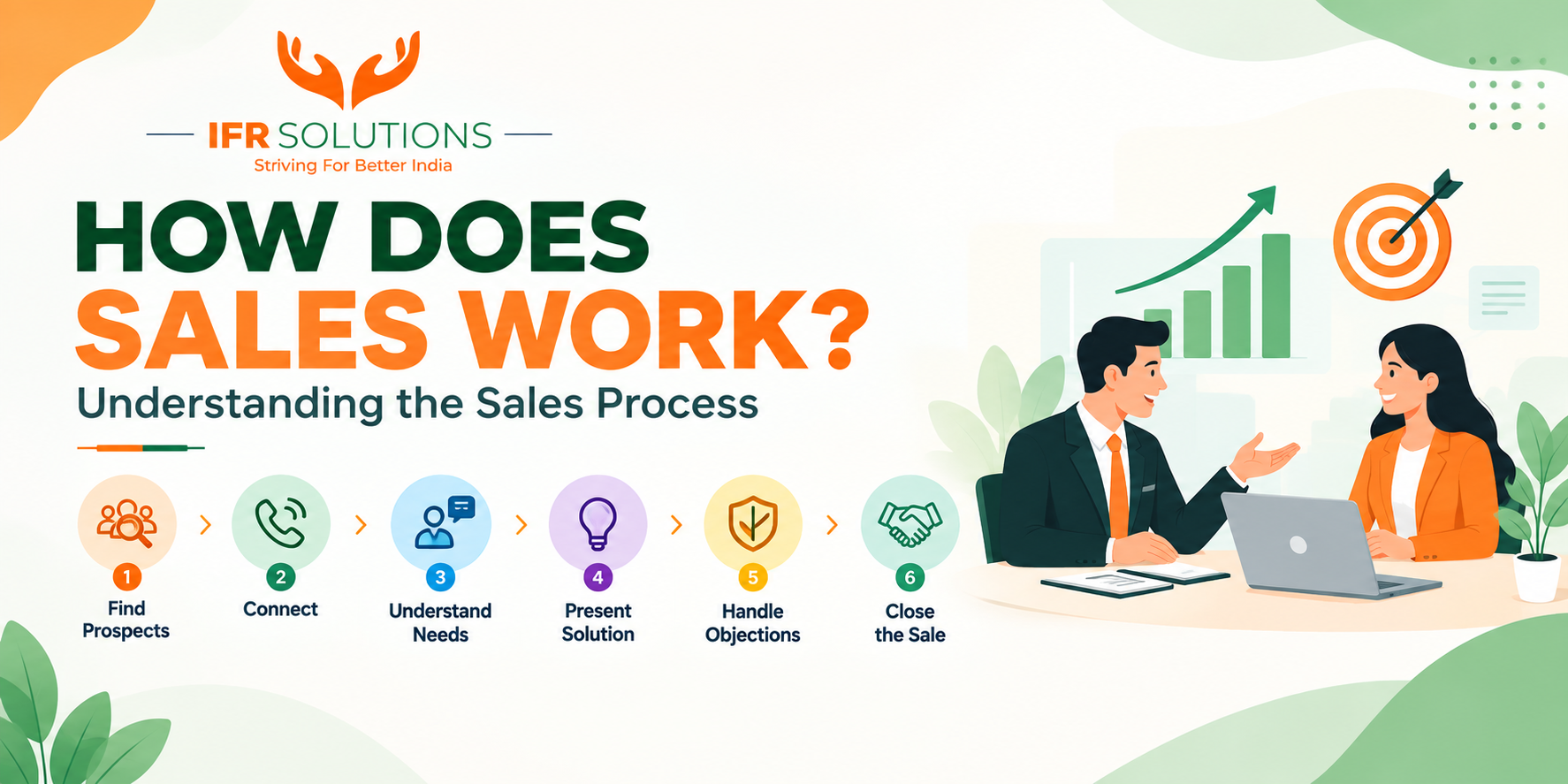
However, most sales journeys follow a similar pattern:
Prospecting → Connecting → Understanding Needs →
Presenting the Solution → Handling Objections → Following Up → Closing →
Building Relationships
Let's look at what happens at each stage.
1. Prospecting: Finding Potential Customers
Before you can make a sale, you need someone to sell to.
That's where prospecting comes in.
Prospecting means finding people or businesses that could
potentially benefit from your product or service.
Businesses can find prospects through different channels,
such as:
- Website
enquiries
- Social
media
- Referrals
- Online
advertising
- Cold
calling
- Email
outreach
- Networking
- Lead
generation campaigns
But here's something worth remembering: more leads don't
always mean more sales.
If the people you're reaching have no need for your product
or service, even a large number of leads may not produce meaningful results.
The goal is to find relevant prospects who have a genuine
need or potential interest in what you offer.
2. Connecting With the Customer
Finding a prospect is just the beginning. The next step is
starting a conversation.
And that first conversation matters.
Customers don't want to feel like they're simply another
name on a sales list. They want to feel understood.
Instead of immediately saying:
“We provide the best solution in the market.”
you could start with something more natural:
“I'd like to understand what you're currently looking for and see if we can help.”
The second approach opens the door for a real conversation.
It gives the customer a chance to explain their situation
instead of immediately listening to a sales pitch.
3. Understanding Customer Needs
This is one of the most important parts of the sales
process.
Before talking about your product, take some time to
understand the person you're speaking with.
Ask questions like:
- What
problem are you currently facing?
- How
are you handling it today?
- What
would you like to improve?
- What
is your biggest challenge?
- What
kind of result are you looking for?
These questions may sound simple, but they can help you understand what the
customer really needs.
For example, a customer might initially say that they are
looking for a cheaper service. After asking a few questions, you may discover
that their real concern isn't price at all. They may actually be unhappy with
the quality of their current service.
That's why good sales professionals don't simply listen to
the first answer. They dig a little deeper.
The better you understand the customer's situation, the
easier it becomes to offer something relevant.
4. Presenting the Right Solution
Now that you understand the customer's needs, it's time to
talk about your product or service.
But don't make the conversation all about features.
A common mistake in sales is explaining everything a product
can do without explaining why any of it matters to the customer.
Let's say your service helps businesses respond to customer
enquiries faster.
Instead of listing technical features, explain the actual
benefit:
“This can help your team respond to enquiries faster, reduce missed opportunities, and create a smoother customer experience.”
That's much more meaningful to the customer.
A good sales presentation should answer a simple question:
“How will this help me?”
When customers can clearly see the connection between their
problem and your solution, the conversation becomes much more valuable.
5. Handling Customer Objections
Almost every sales professional hears objections.
A customer might say:
- “It's
too expensive.”
- “I
need some time to think.”
- “We're
already working with someone.”
- “I'm
not sure this will work for us.”
It's easy to see these statements as rejection. But that's
not always what they mean.
Sometimes, an objection simply means the customer has a
question or concern that hasn't been answered yet.
Instead of immediately defending your product, listen to
what they're saying.
For example, if a customer says:
“It's too expensive.”
Don't immediately jump to a discount.
You could ask:
“I understand. Is the concern the overall budget, or are you comparing it with another option?”
That question can help you understand what's really stopping
them.
The goal isn't to argue with the customer. It's to
understand the concern and respond honestly.
6. Following Up
Not every sale happens during the first conversation.
Sometimes a customer needs more information. Maybe they need
approval from their manager, want to compare options, or simply need some time
to think.
That's completely normal.
This is where follow-up becomes important.
But good follow-up isn't about repeatedly asking:
“Have you decided yet?”
Instead, give the customer a reason to continue the
conversation.
You might send additional information, answer a question
they had, clarify a concern, or explain what the next step would look like.
A helpful follow-up shows that you're still interested in
solving their problem—not just closing the deal.
7. Closing the Sale
Eventually, the customer may be ready to move forward.
This is the closing stage.
Closing doesn't always have to involve complicated
techniques or pressure.
If you've understood the customer's needs and they've
received the information they need, sometimes a simple question is enough:
“Would you like to move forward with the next step?”
Depending on your business, that next step could be:
- Placing
an order
- Signing
an agreement
- Scheduling
a meeting
- Making
a payment
- Starting
the service
The important thing is that the customer understands what
happens next.
A good close should feel like a natural continuation of the
conversation—not something forced.
8. Building a Long-Term Customer Relationship
The sales process doesn't necessarily end after the customer
buys.
In fact, that's where another important part of the customer
journey begins.
After the sale, businesses should continue communicating
with customers, provide support, ask for feedback, and make sure the customer
is getting value from the solution.
Why does this matter?
Because a satisfied customer may come back again. They may
also recommend your business to someone else.
This is why successful sales isn't only about acquiring new
customers. It's also about building relationships that can last.
Why Is a Structured Sales Process Important?
Imagine two salespeople handling the same type of customer.
One follows a clear process: they research the prospect, ask
questions, understand the need, present a relevant solution, follow up, and
record the outcome.
The other salesperson simply calls customers and talks about
the product without any clear approach.
The results can be very different.
A structured sales process gives teams a consistent way to
handle opportunities and customer conversations.
It can help businesses:
- Manage
leads more effectively
- Improve
customer communication
- Track
opportunities
- Identify
where prospects are dropping off
- Improve
conversion rates
- Create
a more consistent customer experience
- Measure
sales performance
It also makes training easier because new team members have
a clear process to learn and follow.
Sales Is About Understanding, Not Just Selling
Customer expectations have changed.
People can now research products, compare prices, read
reviews, and check competitors before making a decision. They don't always need
a salesperson to tell them what a product does.
So what does make a difference?
Understanding the customer.
A strong sales professional knows how to ask the right
questions, listen carefully, communicate clearly, and connect a solution to a
real need.
In other words, the conversation shouldn't be:
“Here's what we sell.”
It should be:
“Here's how we may be able to help.”
That small difference can completely change the way a
customer experiences the conversation.
How Can Businesses Improve Their Sales Process?
Improving sales doesn't always mean making dramatic changes.
Sometimes, small improvements at different stages can make a
meaningful difference.
Businesses can regularly review questions such as:
- Are
we reaching the right prospects?
- How
quickly are we responding to enquiries?
- Are
our salespeople asking enough questions?
- Are
we understanding customer needs properly?
- Where
are potential customers dropping out?
- How
are we handling objections?
- Are
our follow-ups consistent?
- How
long does it take to close an opportunity?
- What
feedback are customers giving us?
The answers can highlight areas that need attention.
Training also plays an important role. Sales teams can
continue developing skills such as communication, active listening,
negotiation, product knowledge, and customer handling.
The more confident and informed a sales team becomes, the
better equipped they are to have meaningful conversations with customers.
Final Thoughts
So, how does sales work?
It starts with finding the right potential customers and
connecting with them. From there, it's about understanding their needs,
presenting a relevant solution, addressing concerns, following up, and helping
them take the next step.
But effective sales is not about pushing someone into making
a decision.
It's about creating value, earning trust, and making the
buying experience easier for the customer.
A strong sales process gives businesses a clear direction
while allowing sales professionals to focus on what matters most—the customer.
Understand the customer first. Build trust through the conversation. Then sell the solution.
Related News